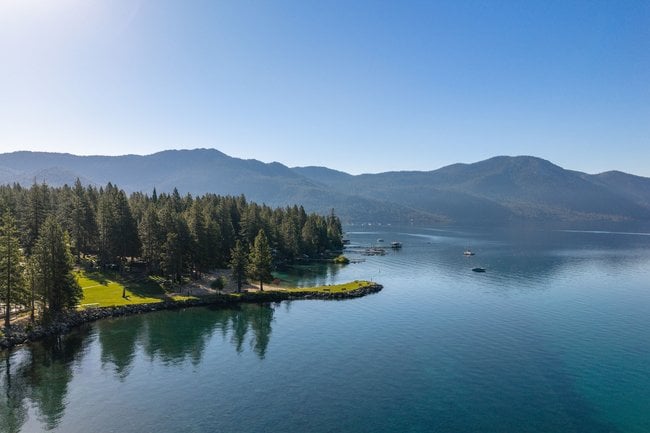
The Tahoe–Truckee–Incline Village real estate market entered 2026 carrying meaningful momentum from a strong 2025, with 1,252 residential sales totaling $2.21 billion. The first six months have been defined by a tension between durable value appreciation and a financing environment that remains, by recent historical standards, expensive. The result is a market that is neither retreating nor euphoric. It is, in the most instructive sense, honest
Through June 30, 482 residential transactions closed for $919 million in total volume. That pace, roughly 80 sales per month, trails 2025's annual run rate modestly, but the more revealing figure is the median price: $1,110,000. That represents a new benchmark for the region, higher than any prior annual median on record, and it has arrived without the frenetic conditions of 2020–2021. Buyers are deliberate. Sellers who price with precision are rewarded while sellers who price aspirationally are educated.
Context is everything in a mountain market. The story traced across two decades of data is not a bubble; it is a repricing of a finite, irreplaceable asset class. The floor of 2009–2013 now looks like an aberration. The 2020–2021 surge, while dramatic, did not create a cliff; it accelerated a trajectory that was already underway.
The current $1.11M median sits 66% above pandemic-era levels and 140% above the floor reached after the global financial crisis. Critically, the average sale price has risen even faster to $1.91M in 2026, reflecting an ongoing shift in the composition of what sells. In 2006, just 20% of transactions closed above $1 million. In 2026, that figure is 55%, and it has held at that level for three consecutive years. The mountain resort has fully evolved from a weekend-cabin economy to a primary and legacy wealth-storage economy.
The region has closed roughly the same number of transactions as last year, but the similarity ends there. Month by month, 2026 has outperformed 2025 on average price per transaction. February set the high point of the year at $2.44M per closed sale, driven largely by extraordinary Incline Village lakefront activity, while March through June maintained consistent velocity in the $1.5M to $2.2M average range.
The region has closed roughly the same number of transactions as last year, but the similarity ends there. Month by month, 2026 has outperformed 2025 on average price per transaction. February set the high point of the year at $2.44M per closed sale, driven largely by extraordinary Incline Village lakefront activity, while March through June maintained consistent velocity in the $1.5M to $2.2M average range.
The buyers writing contracts in this market are not bargain hunting. They are acquiring a finite asset in a place where the supply of meaningful land is constitutionally constrained.
In 2026, 55% of all closed residential transactions exceeded $1 million, a rate that would have been considered an anomaly in 2015, when the same figure was 14%. Above $5 million, H1 2026 has already produced 31 transactions, a pace that puts the full year on track for roughly 60 closings at that tier and a new annual record.
The luxury tier above $10 million has produced 10 closed transactions in H1 alone, equal to the full-year count in 2023 and already matching 2024's total. The Nevada-side lakefront market is the primary driver, but Martis Camp has contributed meaningfully, with multiple closings averaging north of $8 million year to date.
Several transactions in H1 2026 deserve particular attention, not because of their price alone, but because of what they reveal about the depth and character of demand in this market.
919 Lakeshore Blvd | Incline Village | $46,000,000
The defining transaction of 2026. A legacy Nevada lakefront estate that reset the price per square foot benchmark for the entire region. This sale alone represents more volume than the entire Schaffer's Mill community generated in a typical year before the pandemic. Sold by Tahoe Mountain Realty.
740 Lakeshore Blvd | Incline Village | $20,000,000
The second major Nevada-side close of the year, confirming that the $46M transaction was not a solitary anomaly but evidence of a deeply liquid luxury market absorbing supply at elevated price points with meaningful velocity. Sold by Tahoe Mountain Realty.
8458 Valhalla Drive | Truckee | $8,995,000
Closed at full ask in under 24 hours at $1,401/sqft. The Valhalla corridor has produced multiple closings above $7M in under 30 days in 2026, establishing a price floor that the competition is watching carefully.
919 Lakeshore Blvd | Incline Village | $46,000,000
The defining transaction of 2026. A legacy Nevada lakefront estate that reset the price per square foot benchmark for the entire region. This sale alone represents more volume than the entire Schaffer's Mill community generated in a typical year before the pandemic. Sold by Tahoe Mountain Realty.
740 Lakeshore Blvd | Incline Village | $20,000,000
The second major Nevada-side close of the year, confirming that the $46M transaction was not a solitary anomaly but evidence of a deeply liquid luxury market absorbing supply at elevated price points with meaningful velocity. Sold by Tahoe Mountain Realty.
8458 Valhalla Drive | Truckee | $8,995,000
Closed at full ask in under 24 hours at $1,401/sqft. The Valhalla corridor has produced multiple closings above $7M in under 30 days in 2026, establishing a price floor that the competition is watching carefully.
400 West Lake Blvd #5 | Homewood | $6,150,000
Closed above original asking price, a rarity in the current environment. West Shore lakefront continues to attract buyers who value privacy and site over community amenities.
The resort community market is not monolithic. Within Truckee's primary planned communities: Old Greenwood, Gray's Crossing, Lahontan, Schaffer's Mill, Martis Camp, the stories diverge meaningfully in 2026.
Martis Camp is the standout story. 20 closings across homes and homesites at a median home price of $6.7M and active listings are moving in under 40 days on average. The Valhalla corridor has functioned as a genuine sub-market within a sub-market: priced at $1,400+/SF, closing at full ask, with almost no days on market. Martis Camp's 2026 pace projects to roughly $170M in annual home sales from fewer than 1,600 total units, a penetration rate that reflects the community's gravitational pull on Bay Area ultra-high-net-worth buyers.
Schaffer's Mill presents the market's clearest bifurcation: builder absorption sales closing in under a week alongside resale properties that took three to four months and discounts of 6–9% from original ask. Sellers with $4M+ resale aspirations are competing directly against very well finished new construction at $3.5M to $4M.
Lahontan is working through a meaningful supply build. With 17 active homes and 12 active homesites, both well above historical absorption norms. Lahontan is the market's most instructive case study in the relationship between pricing and patience. The properties that have transacted have done so at concessions averaging 8–10% from original ask.
Incline Village deserves its own chapter. At $4.45M average transaction price through H1, the highest in the dataset's history, with 100% of 2026 sales exceeding $1 million and 17.2% closing above $10 million, Incline has fully graduated to a different tier of the real estate conversation. The Nevada tax jurisdiction, proximity to the lake's clearest water, and the community's density cap have created a scarcity premium that compounds year over year.
Entering July, 508 residential listings are active across the Tahoe–Truckee region, the highest count of the year, but still lagging the same period in 2025 by nearly 25%. For buyers, this is ample supply for the moment, likely to dwindle as seasonal absorption kicks in around mid-July. The buyer who knows what they want can find it, tour it, and negotiate from a position of awareness rather than scarcity anxiety. For sellers, the same figure demands precision: properties priced to the market are finding buyers; properties priced to aspiration are generating weekly conversations about reductions.
Entering July, 508 residential listings are active across the Tahoe–Truckee region, the highest count of the year, but still lagging the same period in 2025 by nearly 25%. For buyers, this is ample supply for the moment, likely to dwindle as seasonal absorption kicks in around mid-July. The buyer who knows what they want can find it, tour it, and negotiate from a position of awareness rather than scarcity anxiety. For sellers, the same figure demands precision: properties priced to the market are finding buyers; properties priced to aspiration are generating weekly conversations about reductions.
Currently 29–31% of all active listings carry at least one price reduction, with an average cut of 6.8%. Roughly 30–36 net new properties are joining the active pool each week.
Heading into H2: signals to watch. The Fed held rates at 3.5–3.75% on June 17 with a hawkish tone, and nearly half of policymakers now see rate hikes as possible before year end. For the residential market below $2M, this is a genuine headwind. For the luxury and cash buyer tier, which now represents 55% of regional transactions, it is largely irrelevant. More consequential for the second half may be the IPO liquidity cycle: SpaceX began trading in June at a $2 trillion valuation, Anthropic filed its S-1 targeting a listing in Q4 approaching $1 trillion, and OpenAI is targeting a public debut by year end. Bay Area employees representing 65–70% of TMR's qualified buyer flow are sitting on equity that is, by any historical measure, extraordinary, and it is converting from paper to liquid in real time.
Entering July, 508 residential listings are active across the Tahoe–Truckee region, the highest count of the year, but still lagging the same period in 2025 by nearly 25%. For buyers, this is ample supply for the moment, likely to dwindle as seasonal absorption kicks in around mid-July. The buyer who knows what they want can find it, tour it, and negotiate from a position of awareness rather than scarcity anxiety. For sellers, the same figure demands precision: properties priced to the market are finding buyers; properties priced to aspiration are generating weekly conversations about reductions.
Heading into H2: signals to watch. The Fed held rates at 3.5–3.75% on June 17 with a hawkish tone, and nearly half of policymakers now see rate hikes as possible before year end. For the residential market below $2M, this is a genuine headwind. For the luxury and cash buyer tier, which now represents 55% of regional transactions, it is largely irrelevant. More consequential for the second half may be the IPO liquidity cycle: SpaceX began trading in June at a $2 trillion valuation, Anthropic filed its S-1 targeting a listing in Q4 approaching $1 trillion, and OpenAI is targeting a public debut by year end. Bay Area employees representing 65–70% of TMR's qualified buyer flow are sitting on equity that is, by any historical measure, extraordinary, and it is converting from paper to liquid in real time.
Entering July, 508 residential listings are active across the Tahoe–Truckee region, the highest count of the year, but still lagging the same period in 2025 by nearly 25%. For buyers, this is ample supply for the moment, likely to dwindle as seasonal absorption kicks in around mid-July. The buyer who knows what they want can find it, tour it, and negotiate from a position of awareness rather than scarcity anxiety. For sellers, the same figure demands precision: properties priced to the market are finding buyers; properties priced to aspiration are generating weekly conversations about reductions.
Currently 29–31% of all active listings carry at least one price reduction, with an average cut of 6.8%. Roughly 30–36 net new properties are joining the active pool each week.
Every season delayed is not merely a financial abstraction — it is mornings on the water that don't happen, winter evenings by a fire that remain hypothetical, summers with children at ages they will never be again. The buyers who moved in 2019 didn't know what 2020 would bring. The buyers who moved in 2022 didn't know what 2024 would bring. What they knew — and what the data has consistently validated — is that the mountain doesn't wait, and neither should they.
Every season delayed is not merely a financial abstraction — it is mornings on the water that don't happen, winter evenings by a fire that remain hypothetical, summers with children at ages they will never be again. The buyers who moved in 2019 didn't know what 2020 would bring. The buyers who moved in 2022 didn't know what 2024 would bring. What they knew — and what the data has consistently validated — is that the mountain doesn't wait, and neither should they.
The best time to buy a place that aligns with who you are and how you want to live is when you find it and can afford it. That has been true in every year this market has existed, and it is true now.